Creator sounds like the same generic robot (AI)
SITUATION
In 2026, AI didn't solve the content problem; it created a "homogenisation crisis" where every creator sounded like the same generic robot.
The Landscape: I identified a massive market gap in which AI efficiency was eroding personal brand equity. Top-tier designers were trading their "signature" for speed, leading to a total dilution of identity.
The Stakes: If everyone uses the same LLM defaults, the value of a "personal brand" drops to zero. I saw the need for a system that prioritised context as Currency.
The Pivot: I moved from thinking about "Generative AI" to "Signature AI", focusing on how to protect a user’s unique voice while leveraging 2026-level automation.
TASK
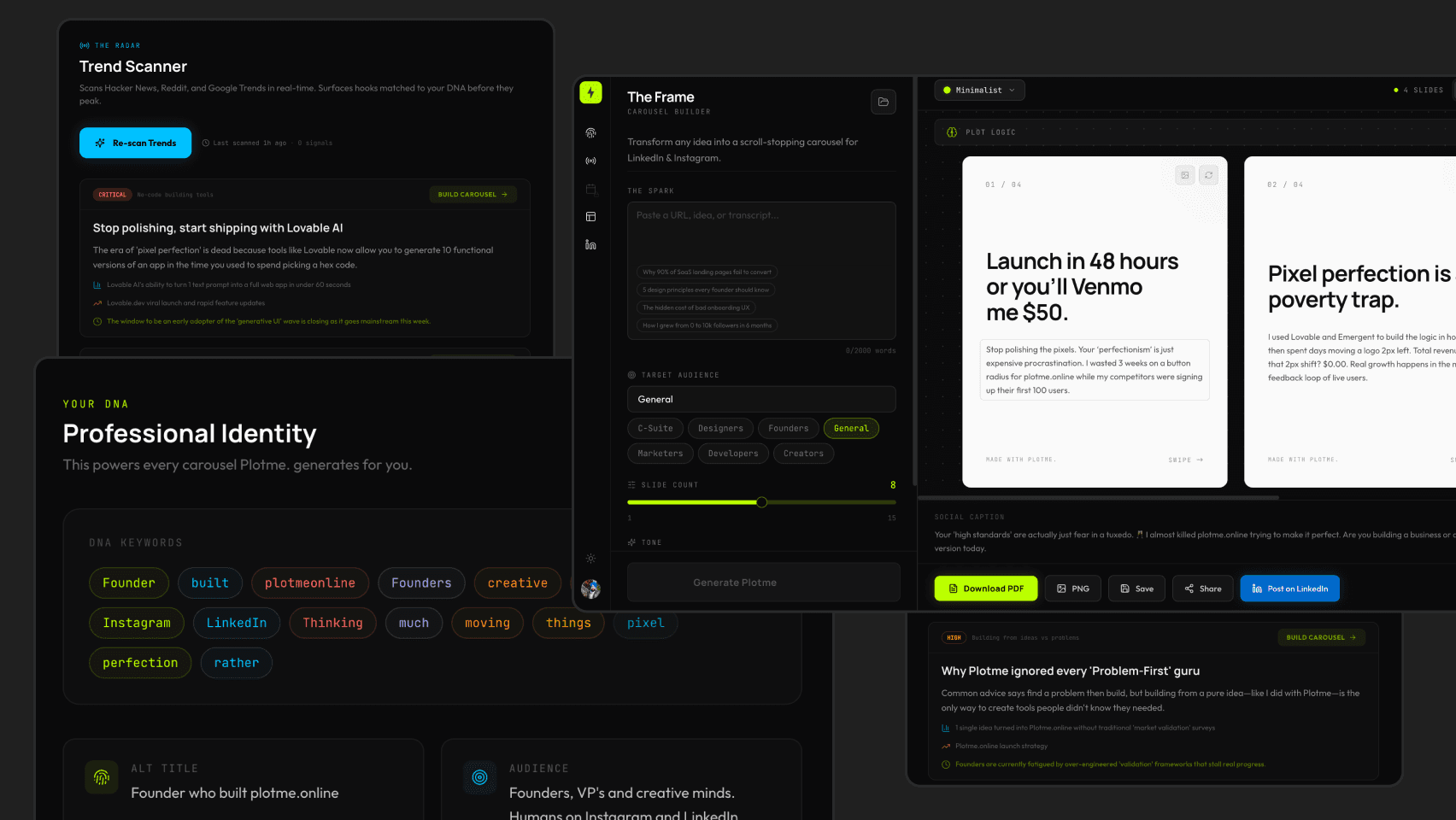
My mission was to build an editorial engine that treated prompt architecture as a design system, transforming raw AI into a nuanced personal ghostwriter.
The Objective: Build "Plotme", a Personal Brand OS within an aggressive 8-week window as a solo founder.
The Metrics: The goal was not just "output" but high-intent conversion. I needed to move the needle on DNA completion rates and Pro-tier upgrades.
The Constraints (Challenges): I faced a "technical wall" regarding state management on a no-code backend and a "geographic wall" with payment processing (Razorpay vs. Stripe), requiring high-level innovation under pressure.
ACTION
I replaced "magic" with "epistemic trust", designing a transparent AI experience that proves its logic rather than asking for blind faith.
Communication: I articulated a "dark luxury editorial" aesthetic to the users. This wasn't just a style choice; it was a communication strategy to signal that PlotMe. is for serious thinkers, not casual "content creators".
Collaboration: I led a collaborative feedback loop with two polarised cohorts: design directors and students. I had to navigate the challenge of senior leaders fearing the "Industry Villain" prompt, reframing it from "negativity" to "thought leadership" to achieve alignment.
Counterfactual: I explicitly rejected a "LinkedIn OAuth Auto-Import" feature. While easier for the user, the counterfactual analysis showed it would only scrape their past boring headlines. I chose strategic friction, forcing users to answer 7 deep questions, to capture their future trajectory instead.
Innovative Interaction: To solve the 10-second latency challenge, I designed "optimistic rendering" text blocks. This communication tactic transformed a technical lag into a "value-add" moment by explaining the AI’s strategic logic to the user in real-time.
RESULT
PlotMe achieved a 75% DNA completion rate, smashing industry averages, and proved that high-intent friction is the ultimate driver for Pro conversions.
Hard Metrics: By focusing on the "Villain" prompt, I saw a 4× higher Pro conversion rate for users who leaned into the friction.
The Human Result: The ultimate result was qualitative: users reported that their peers couldn't tell AI was involved. We successfully automated the craft without losing the soul.
The "Cutting Room" (Counterfactual): I cut "Auto-Posting" and "Light Mode" to ensure the core value—the Voice—was flawless. I chose a "signature brand" over a "feature-rich tool".
"I don't just design interfaces; I design the invisible logic systems that allow humans to scale their intuition without losing their identity."