One Branding Brain
Turning one creative director's judgment into a service that scales.
PAIASTAR is a one-person branding practice. The work was deciding what an AI assistant could safely take off the founder's plate — and what had to stay his, permanently.
Role: Lead Product & Service Designer
Scope: Service model, MVP site, AI interaction design
Partner: Justin Hancock, founder & creative director
Stage: Live MVP, content finalization in progress
01 The Problem:
PAIASTAR sells one person's creative judgment which is 30 years of human experience. The bottleneck was never demand. It was that every client had to go through Justin personally, one call at a time, before anything else could happen.
Branding clients don't arrive with a brief. They arrive with a feeling, "I need to look more credible," "I don't know what my brand is." Someone has to turn that into something workable before any creative process can start. Today, that someone is always Justin.

02 Role & Scope:
I worked directly with the founder as his only design and service partner: no separate research, engineering or product team.

03 The Service
The real project wasn't the website. It was moving the first mile of a 1:1 service onto AI, while keeping every judgment call with Justin.

AI takes the first mile. Justin keeps the last one: review, premium work, and anything that needs a real conversation. The shipped version split PAIA into two named characters instead of one generalist assistant: a real product decision made after the spec, not a deviation from it. Site structure and copy are still mid-build: the shipped nav (Home / About / Solutions / Contact) and several sections are running on unfinished content at the moment.
04 What we learned
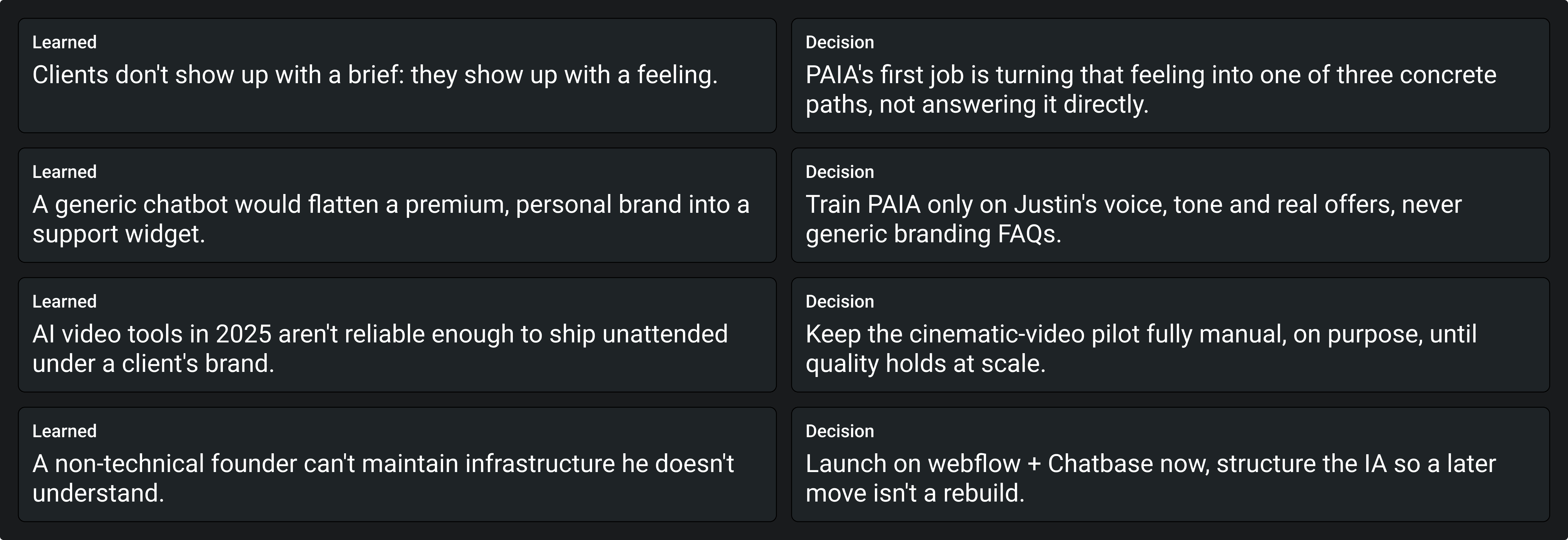
Four things shaped every decision after this. Each one changed what got built, not just how it looked.
05 Designing the MVP
One flow, kept intentionally short: land, talk to PAIA, get routed, preview, pay, get reviewed, receive.
Land → Talk to PAIA → Get routed → Preview draft → Unlock kit → Human review → Delivery
PRD Mockup

Live Paiastar webflow

The identity shifted from the specced violet-blue-orange gradient system to a bolder black-and-lime editorial type treatment, a real design decision made in the build, not a drift from the brief. The mechanism held: chat-first entry, then a menu of concrete offers.

06 Service Design Decisions
The decisions that actually determine whether an AI-assisted service feels trustworthy.
Trust:
Every AI draft is gated behind a human before a client sees it
Nothing PAIA produces ships unreviewed. The client never sees "raw AI": they see Justin's edition of it.
Uncertainty
No defined fallback yet for an off-track answer, an open gap, not a solved one
Current mitigation: everything AI touches is a draft. A weak understanding produces a weak draft, not a bad client outcome, because review still sits in between.
Escalation
"Book a Call" is a designed escape hatch, not an afterthought
For anything a chatbot or a fixed-price kit genuinely can't handle, the funnel hands off to a real conversation with Justin.
Feedback loop
Client revisions currently go back to Justin only, not into PAIA
That's a known gap. Closing it: intent tracking feeding PAIA's training is the next thing on the roadmap, not something already built.
07 Outcome & Next Steps
No usability testing or client data exists yet, this is pre-launch. Here's what's actually true versus what's next.
Confirmed
Service model, brand system and IA designed and specified
MVP is live at paiasta.webflow.io with a working Chatbase integration
Platform and phased pricing strategy decided and documented
Human review gate defined as a non-negotiable policy, not a feature toggle
Single-assistant concept evolved into two named AI characters (Alpha / Sage) in the shipped build
Proposed / next and open questions
Finish placeholder copy still live on the four solution cards
Validate the 3-track / two-character structure with real prospective clients
Close the feedback loop from revisions back into PAIA
The hard part wasn't getting AI to generate something. It was deciding what it should never be allowed to decide.


